
Mobile
Laboratory
What Can It Do For You?
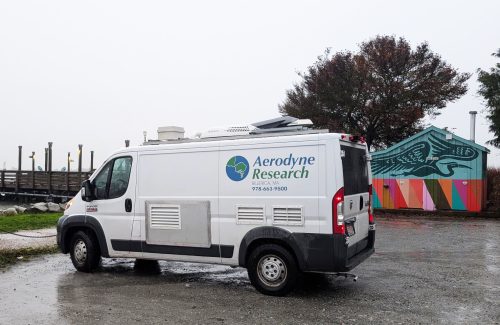
The Aerodyne Mobile Laboratory has a suite of instrumentation that changes depending on the requirements of the measurement campaign. Our experts in various fields are available to join your campaign.
Capabilities
The mobile lab has traveled the globe conducting various types of research. In addition to our full size lab, we also have a smaller lab (minAML).
Fenceline Monitoring & Leak Detection
Real-time detection and source identification of equipment leaks can be attained through mobile fenceline and on-site surveys.
Pollution Heatmaps
Intensive mapping of industrial pollutant emissions has been used to characterize the the impact on downwind residential populations.
Emission Rate Quantification
Using tracer release methods, the Aerodyne Mobile Laboratory quantifies oil and natural gas emissions across North America, from well pad to whole facility scale.
Alternative Platforms
Aerodyne has installed suites of instruments aboard aircrafts and ships of various sizes.

Field Campaigns
Air Quality in Cities
A full suite of trace gas, PM, and VOC instruments has been used to investigate industrial emissions and other air quality concerns in several major cities.
Oil and Natural Gas Facility Measurements
Tracer release studies have been conducted with the Aerodyne Mobile Laboratory to quantify emissions across the oil and natural gas supply chains at over 750 sites.
Wildfire Smoke Emissions
Aerodyne has participated in the NOAA and NASA FIREX campaigns as part of a multidisciplinary team studying forest fire emissions.
Offshore Platforms
Emissions from offshore oil and gas platforms in the Gulf of Mexico were measured with a suite of instruments installed on a boat, including methane, ethane and the isotopes of methane.
Subsurface Microbial Research
Aerodyne is teaming up with soil and environmental researchers to quantify a wide range of subsurface gases using TILDAS and Vocus technologies.
Agricultural Emissions
Methane emissions associated with the agricultural use of cows have been quantified at several farms in central California.
Ozone Precursors in Detroit, MI
The Aerodyne Mobile Laboratory participated in the Chemical Source Signatures (CHESS)
sub-experiment as part of the Michigan-Ontario Ozone Source Experiment (MOOSE).